Laurel ONeill Electrical Engineer, Teacher, Academic
I am a graduate student, soon to be PhD at Penn State Studying electrical engineering. My fields of research include engineering education and standoff optical spectroscopy. I am a subject matter expert in course development, deep ultraviolet Raman spectrscop, laser induced breakdown spectroscopy, and optical instrument design. I have also dabbled in broadband antenna design.
Teaching Statement
Education is the important first step to becoming a successful and competent engineer. My educational philosophy is that Education needs to be driven by student and societal needs in tandem, and it must be as accessible and engaging as possible. As an instructor, that means that I need to be prepared to alter material and timelines to suit the needs of the class as well as adjusting materials. In addition to being driven by needs of students the material in all classes needs to be accessible and engaging. It must be available in multiple formats for students with visible and invisible disabilities, as well as able-bodied students. Material should not be obfuscated behind jargon but instead use the words necessary to describe the topic most directly. Whenever possible, classes I teach will involve demonstrations and labs. Since most students will be working in a team setting after graduation, team projects and labs will also be used. Based on my experience as an instructor and student, this is one of the most effective ways to ensure student engagement. In addition to student labs, I will leverage the connections to industry and other labs to show students the relevance of their work. In the classes I've taught students have appreciated the insight into the material granted by having outside presenters from industry and academia.
We need to be ready to take risks and try new things as instructors. I want to build more practicum and hands-on courses to enable students to contribute to research on campus. In my experience when given the knowledge, as well as the infrastructure and experience, students will take chances and experiment on their own. Courses like this will inevitably need to be open-ended, because this gives students the freedom to make mistakes and learn from their mistakes. Mistakes are great teachers, but mistakes take time. We need to be prepared to be flexible in time so students can afford to make mistakes. In addition to that whenever possible I will incorporate "all-in-one" instruments into my classes. Tools such as the National Instruments myDAQ and Liquid Instruments Moku:Go are accessible to students and empower them to experiment on their own time. Broadly incorporation of these tools should occur curriculum wide. It's important to affect change in your own classroom, but we need to be willing to look at education as a whole. This may involve curricular changes, changing education paradigms, and the nature of a university education.
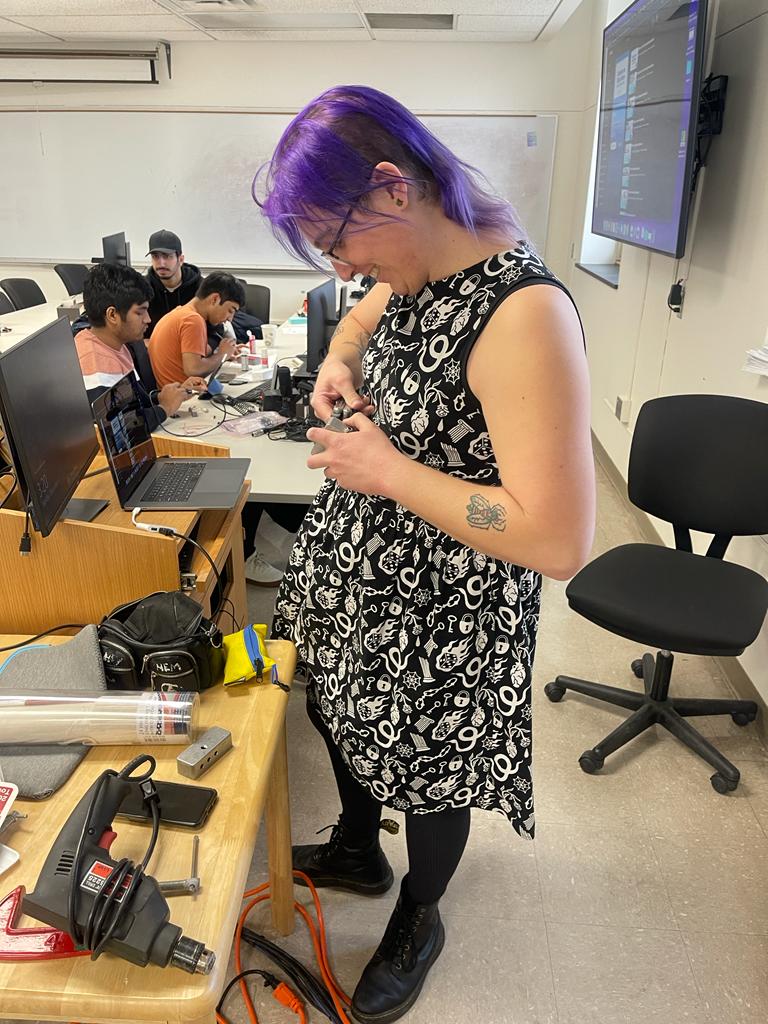
I put my educational philosophy into practice through three courses that I developed and taught, and whenever possible in the courses I was a TA for. I have developed and taught two hands-on courses in optics and photonics at both a first-year and fourth-year level. Each course was delivered using a mini-lecture/lab paradigm; a 15-20 minute lecture introducing the topic and goal of the session was given followed by an hour of experimentation where the students attempted to meet the goal. The first year course was broadly a survey on optics, while the fourth-year course was focused on applied spectroscopy. Each course had guest lectures, and students in the fourth-year course were required to keep ad-hoc lab notebooks. The third course I developed and taught used the same paradigm as the courses I mentioned previously. This course was intended as an introduction to electrical engineering and circuits through audio effects and electric guitar for first-year engineering students. Students were presented with several audio effects and their circuits. They were then tasked with replicating the circuits. Through the experiments in this course and presentations given by guest lecturers, students were exposed to a broad swath of electrical engineering.
Moving on from the explicit classroom portion of education, I believe it is also necessary to address the issues that Justice, Equity, Diversity, and Inclusion (JEDI) plays in education as well. As a neurodivergent and transgender individual, I am aware of the challenges that come with navigating academic spaces with marginalized identities. Students of all identities need to be encouraged to stay in these fields and be supported through their time as students. This falls outside the traditional role of an instructor, but I believe mentoring students and guiding them to available resources is an important part of being an educator and mentor. In the work of Hughes et al. "Coming out in STEM: Factors affecting retention of sexual minority STEM students" (Science Advances, 2018) it is made clear that involvement in undergraduate research was a strong factor in the retention of LGBTQ students. Broadly, I will apply that to attract and retain women, first generation students, and students from underserved communities as well. As an instructor, I consider it my responsibility to connect my students to research and opportunities that will enrich their academic experience. To support this goal, I plan to apply for an NSF REU site focused on getting undergraduate students experience in optical systems and that makes use of my connections at my alma mater and my potential department.
Given the scope of my teaching philosophy and my desire to innovate within education, I plan to apply for the NSF Research Initiation in Engineering Formation to enable me to push the boundaries of engineering education. My goal as an instructor is to inspire my students to learn on their own and empower them to ask hard questions. I want to dismantle hierarchies in the classroom so that my students have the most resources available to them and the power to access them. My favorite thing to hear from students is: "I had a question about the material outside of class so I googled it, and I learned ....". Hearing things like that has confirmed for me that I have been constructing my course materials correctly, and that teaching ins the way I can make the most positive impact in my community and field.
Research Statement
My research exists at the intersection of multiple fields that span from spectroscopy, environmental contamination in water and air, fluid dynamics and engineering education. Research of mine has included standoff and bench top spectroscopy to examine the effects of fertilizer runoff, the seasonal variation of agricultural contamination in water ways, and the spread and diffusion of emissions from livestock farms, and the formation of plasma and bubbles in liquids under intense optical radiation. In particular, the formation of plasma and bubbles is of interest given the intersections of optical physics, fluid dynamics, acoustics, and plasma physics. This example has potential impacts to photochemistry, additive manufacturing, and plasma medicine. Lastly, my final major research interest is the intersection of engineering education and the factors that lead to academic and career success in engineering.
Given the broad scope of my research interests, I believe its necessary to break them down. I want to develop novel techniques and measurement systems to assist and revolutionize the work of my collaborators. I will connect researchers to spectroscopic and non-contact measurement techniques that can improve the outcomes of their research. I have extensive experience with deep ultraviolet (DUV) Raman and fluorescence spectroscopy. The major advantages of DUV Raman spectroscopy are that the Raman cross section is approximately sixteen times higher than in the visible. In addition to that, when the probe wavelength is smaller than approximately 250nm, the fluorescence signal is separated from the Raman signal allowing for easier detection. Given the limitations and challenges of DUV lasers and suitable detectors this will necessitate staying abreast of new technological innovations. For broader integration and applications of DUV Raman spectroscopy new lasers and detectors will need to be developed. Additionally my experience with laser induced breakdown spectroscopy (LIBS) provides another method of observation to corroborate the results of Raman spectroscopy. During future research I will improve the signal to noise ratio of small LIBS systems as well as developing ways to make the analysis of bulk liquid samples more accurate and precise. This segues into my interest in fluid and plasma dynamics. The plasma and bubble formation in liquids under high intensity laser radiation, as in LIBS, is a challenging problem that ties together several fields. At this time little work has been done in that field to examine the impact of the viscosity and physical properties of the fluid under inspection and impact of the vessel containing the sample. For example, high viscosity fluids tend to damp out the oscillations of bubbles as well as keep the bubbles in place. This last point presents an issue for automated measurement systems since the sample volume is effectively destroyed.
In addition to my bench research, an important subset of my research is improving engineering education with a focus on both hands-on/experiential learning and the intersections of marginalized identities and academic success. While at Penn State I developed and taught three new classes, each of which had a strong emphasis on hands on experimentation as part of the learning process. Two classes of the three classes were on optics and spectroscopy. They were aimed separately at first year and fourth year undergraduate students. These classes resulted in two conference publications and presentations at both the American Society for Engineering Education (ASEE) Zone 1 conference and the Engineering and Training in Optics and Photonics (ETOP) conference hosted by the International Society for Optics and Photonics (SPIE). The third class I developed was an introduction to electrical engineering for first year undergraduates using audio effects and electric guitar as an example throughout the semester. Given the past success in my experiments with hands-on education I plan to continue this work on course development into the future. Regarding academic success, I want to delve into the experiences of students with multiple marginalized identities and the impact their marginalized status has on academic success. One way that I investigated this in the past was hosting a panel examining the experiences of queer graduate students with support from the Leonhard Center for the Enhancement of Engineering Education. This was presented to faculty in the College of Engineering and has resulted in a conference paper for ASEE currently under review. I believe that we as engineers need to address these issues, so that as a society we have the most capable folks working on the challenges we will face.
During my graduate career, I've become well versed in the application of single pulse nanosecond laser induced breakdown spectroscopy and built an expertise in Raman spectroscopy. Over the years, I've also developed antennas for spacecraft and ground stations while working with BAE Systems, formerly Ball Aerospace and Technologies Corp, in Boulder Colorado. as well as working as communication subsystem lead and lab manager for the OSIRIS-3U cubesat, developed at Penn State.
Regarding funding my bench research I plan to pursue grants largely from the Office of Naval Research, the US Department of Agriculture, the Environmental Protection Agency, and Department of Energy. When it comes to my human studies research on engineering education, I have plans to apply for an NSF REU site focused on getting undergraduate students experience in optical systems, and an NSF Professional Formation of Engineers: Research Initiation in Engineering Formation grant. To me the two sides of my research, bench and human studies, work in tandem and support each other.
During my graduate and undergraduate careers, I've interacted with many fields of research and utilized many different technologies and measurement techniques. I've learned that I want to continue to learn and contribute to many fields. The best way for me to do that is to build strong networks for collaboration and by conducting interdisciplinary research.
DEI Statement
As a transgender and neurodivergent person in academic spaces, I've felt the pressures of transmisogyny and neurotypical assumptions. The experiences I've had have led me to believe that lack of DEI presents a serious issue in the field of engineering, and if we don’t address it we’ll be lacking engineers with the broad knowledge we need. When it comes to solving engineering problems it is necessary that all stakeholders are involved if we want a good and equitable solution. When talking about efforts to improve the diversity and equity of academia, I prefer the acronym JEDI, Justice, Equity, Diversity and Inclusion as opposed to DEI. Justice to historically marginalized and stigmatized identities needs to be rendered before we can expect diversity to occur. The deliberate impact of practices such as redlining, voter suppression of black and brown communities, gentrification, and destruction of black and brown communities by academic infrastructure, as well as the lasting impact of slavery, and the HIV/AIDS epidemic need to be addressed. Once justice is rendered and equitable access to resources are available, can we as an academic community begin to approach diversity and inclusion systemically. Based on my experience in the environment and the academic literature, students of marginalized identities often face financial hardship, lack of community, dismissal of their work, and outright discrimination. These issues need to be addressed.
During my graduate studies I've been actively involved in community organizing to address systemic issues. The following are efforts that I have done within my community:
- I planned a biweekly happy hour for queer graduate students
- I organized a panel on the experiences of queer and trans graduate students for the ASEE zone 1 conference in 2023. This was ultimately run again in June of 2023 for faculty, administrators, and staff of Penn State with assistance from the Leonhard Center for the Enhancement of Engineering Education
- I organized grassroots efforts to build transgender community in central Pennsylvania through seminars on accessing hormones and safe/effective consumption, as well as community building events such as regular potluck dinners
- I was actively involved in providing food and shelter to unhoused community members during the Covid-19 pandemic
Whenever I've been in a position to affect change I have made the most of it. I will continue that at whatever institution I land at. In my classes, I plan to make sharing of chosen names and pronouns a common occurrence. As a transfemtoma and non-binary person, practices like this would have gone a long way towards improving my comfort in academic spaces. In addition to that based on my identity as an able-bodied, white, neurodivergent, transgender lesbian, I plan to use my identity to provide the safest and most effective mentoring to both graduate and undergraduate students. Whenever possible, I will encourage minority students to get involved in undergraduate research. As Hughes et al. stated in their work "Coming out in STEM: Factors affecting retention of sexual minority STEM students" (Science Advances, 2018), being involved in undergraduate research was a significant factor in the retention of LGBTQ students within STEM programs.
I plan to build queer community and affinity groups within my community, and whenever possible within my department. This serves my desire for that type of community while also addressing a need in the community at large.
In addition to my desire to help queer students and faculty, I also want to assist neurodivergent and disabled students. This group has historically had challenges advocating for themselves within academic and work settings due to multiple systems of oppression. I will add my voice as an advocate for those who need it, while empowering those who are capable of advocating for themselves. I plan to work with experts who occupy these identities to support the folks who I am able to, while recognizing and honoring the agency of those who do not want my support. It is important that outreach welcoming women, first-generation students, and students of color to the field must continues.
Lastly, I would like to develop an award open to undergraduate and graduate students who have contributed to make their department and their community more just, equitable, diverse, and inclusive. These issues are hard to solve and are going to take work from everyone. I believe the people doing that work deserve to be recognized and empowered to do more. JEDI issues represent a crisis in the field of engineering and for me personally. We will be lacking engineers if we continue to exclude groups, and we will be hurting the pool of knowledge via this exclusion. Diversity of experience leads to diversity of thought and that's what we need to tackle the issues facing society as a whole.